Study on the Particle Tracking and Dispersal Near the Coral Reef in MBRS Using Multiple Two-way Nested-grid Ocean Circulation Model
The multiple two-way nested-grid (MTWN) ocean circulation model is developed in the Meso-American Barrier Reef System (MBRS) based on the two-way nested-grid ocean circulation model developed by Sheng and Tang (2003, b). The model system consists of the outer model in the Western Caribbean Sea (WCS) developed by Sheng and Tang (2003, a), with 19 km coarse resolution roughly, middle model in the MBRS with 6 km finer resolution roughly, which covers the area between 84°W and 89°W and between 15.5°N and 20°N, and inner model in the Coral Reef (CR) with 2 km finest resolution roughly, which covers the area between 87.375°W and 88.5°W and between 15.75°N and 17.625°N. All the ratios between two neighboring models are about 3.0.
Outer model variables are interpolated onto the middle grid to provide the boundary conditions for middle model. Middle model variables are interpolated onto the outer grid in the common subregion of the outer model as the information feedback; Middle model variables are also interpolated onto the inner grid to provide the boundary conditions for inner model. Inner model variables are interpolated onto middle grid again in the common subregion of the middle model as the information feedback.
The semi-prognostic method proposed by Sheng et al. (2001) is used to exchange information between inner and middle models and between middle and outer models through the model momentum equations. The smooth semi-prognostic method proposed by Eden et al. (2003) is used to average the meso- and large-scales features spatially in the MBRS so that more small-scale features can be reproduced in the CR.
A Lagrangian view of the circulation is generated using a fourth-order Runge-Kutta method in this study. The particle tracking and dispersal in the CR are analyzed at the different water-depth levels horizontally. The index of retention is used to describe the particle tracking and dispersal of the laval in the CR.
The MTWN model is initialized with the January mean temperature and salinity and forced by the monthly mean COADS (Comprehensive Ocean-Atmosphere Data Set) wind stress and surface heat flux. The model sea surface salinity is also restored to the monthly mean climatology. The MTWN model is integrated for two years and the second year model results are presented in this study. The annual mean near-surface currents over the MBRS calculated by the middle model agree reasonably well with the time mean near-surface currents inferred by Fratantoni (2001) from trajectories of the satellite-tracked 15-m drogued drifters in the 1990s. The middle model also reproduced the recirculation known as the Honduras Convergence at the Gulf of Honduras. The meso-scale circulations from the inner model simulation are consistent to that in the middle model. On the other hand, the inner model produced more small-scale features in the CR area.
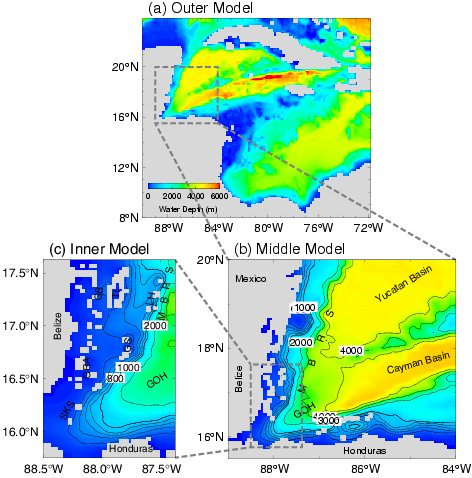
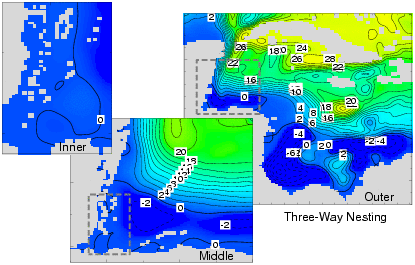
Fig. 1: The domains of the three models: Inner, Middle and Outer Fig. 2: Annual mean near-surface volume transport streamfunction
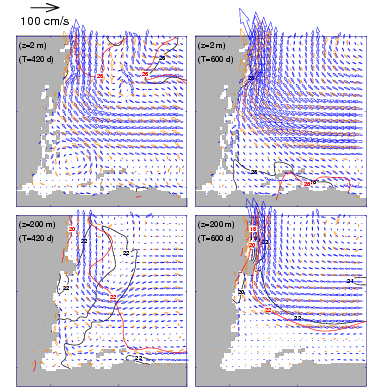
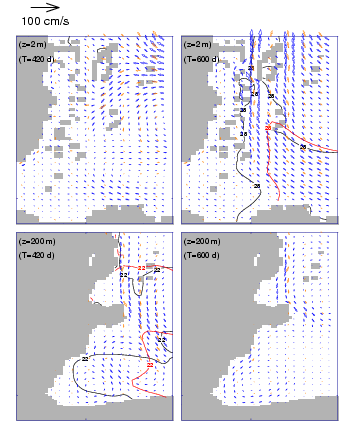
Fig. 3: Comparison of the currents from outer and middle models in Fig. 4: Comparison of the currents from middle and inner models
the common subregion of the outer domain. Yellow means outer in the common subregion of the middle domain. Yellow means
model currents and blue means middle model currents middle model currents and blue means inner model currents
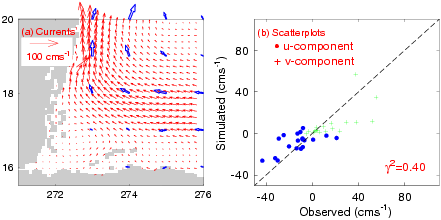
Fig. 5: (a) Comparison of the middle model-calculated and observed near surface currents. Red indicates
model calculation and blue indicates observation over the MBRS; (b) Scatterplots of observed and model-
calculated time-mean near-surface currents from the middle model simulation
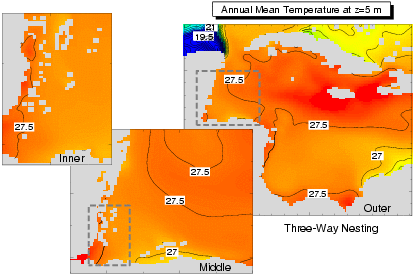
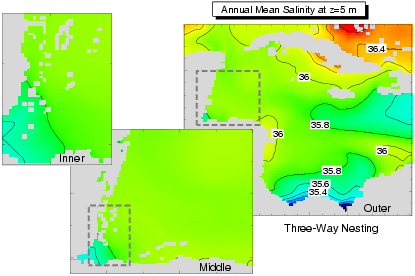
Fig. 6: Annual mean near-surface temperature from model calculations Fig. 7: Annual mean near-surface salinity from model calculations
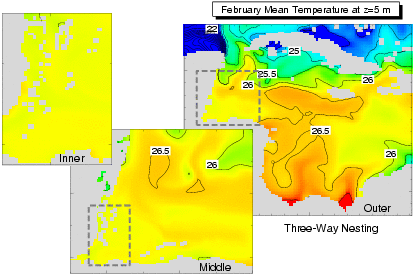
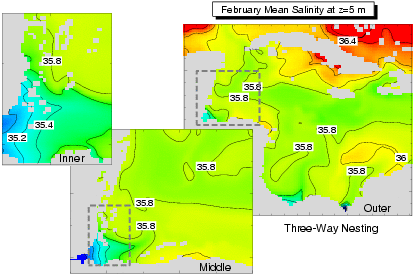
Fig. 8: Monthly mean near-surface temperature from model calculations Fig. 9: Monthly mean near-surface salinity from model calculations
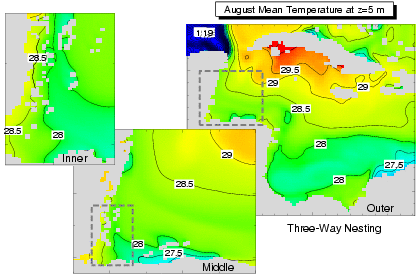
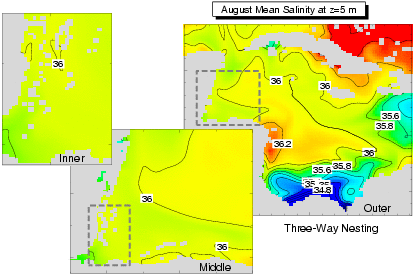
Fig. 10: Monthly mean near-surface temperature from model calculations Fig. 11: Monthly mean near-surface salinity from model calculations