|
A Modeling Study of Physical Processes of Ocean Circulation over the Meso-American Barrier Reef System (MBRS) |
 |
|||||
|
Liqun Tang
and
Jinyu Sheng
Department of Oceanography,
Dalhousie University, Halifax, NS, B3H 4J1, Canada
Collaborators: Richard J.
Greatbatch, Bruce Hatcher and Barry Ruddick
|
 |
|||||
|
1: Introduction A two-way nested-grid ocean circulation model is developed for the Meso-American Barrier Reef System (MBRS). The model has a fine-resolution (6 km) inner model embedded in a coarse-resolution (19 km) outer model. We follow Sheng et al. (2003) and use the semi-prognostic method to exchange information between the inner and outer models through the model momentum equations. We calculate the annual mean transport streamfunction, currents, temperature and salinity from the second year model results. We demonstrate that the boundary forcing of the outer model and local density gradients play a very important role in driving the general circulation in the MBRS. The surface local wind forcing plays an important role in driving the near-surface circulation, but plays a secondary role in driving the depth integrated flow in the region. 2: Objectives
The main objectives of
this study:
a. to apply a two-way nested-grid primitive equation ocean circulation model to the MBRS to study general circulation and temperature/salinity distributions in the region; b. to examine the role of the local wind stress, boundary forcing and local density gradients in the MBRS 3: A new two-way nesting technique a: Outer model variables are interpolated onto the fine grid to provide the boundary conditions for the inner model. b: Inner model variables are interpolated onto the coarse grid in the common subregion of the outer model as the information feedback. c: The semi-prognostic method is used to exchange information between the inner and outer models through the model momentum equations. Hydrostatic equation:
For the inner model:
For the outer model:
4: Ocean circulation model
a.
Three-dimensional, baroclinic and fully nonlinear
b.
z-level and fourth order of accuracy
c.
Computationally efficient
d.
Has been applied to many other regions
Horizontal resolutions:
1/18 degree, or about 6 km for inner model;
1/6 degree, or about 19 km for outer model
Vertical resolutions:
Non-uniform with total of 31 z-levels in both of the inner and outer models;
The top 5 z-levels are located at 5, 16, 29, 44 and 61m.
Model external forcings:
a. Surface wind stress (COADS
0.5-by-0.5 climatology).
b. Surface heat flux (COADS 0.5-by-0.5 climatology).
c. Sea surface temperature and salinity (SST, SSS)
d. Currents through the open boundaries calculated by coarse resolution models.
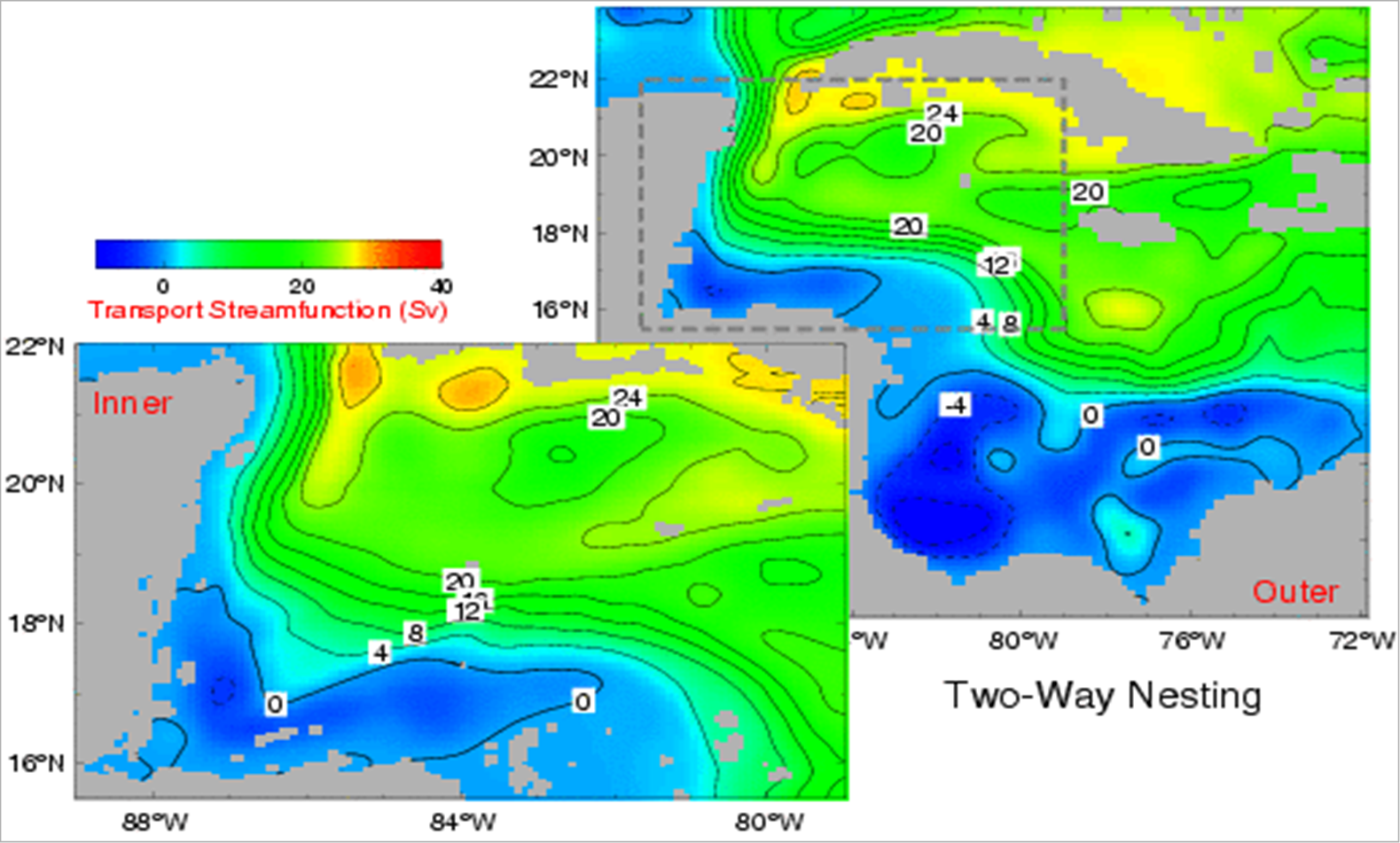
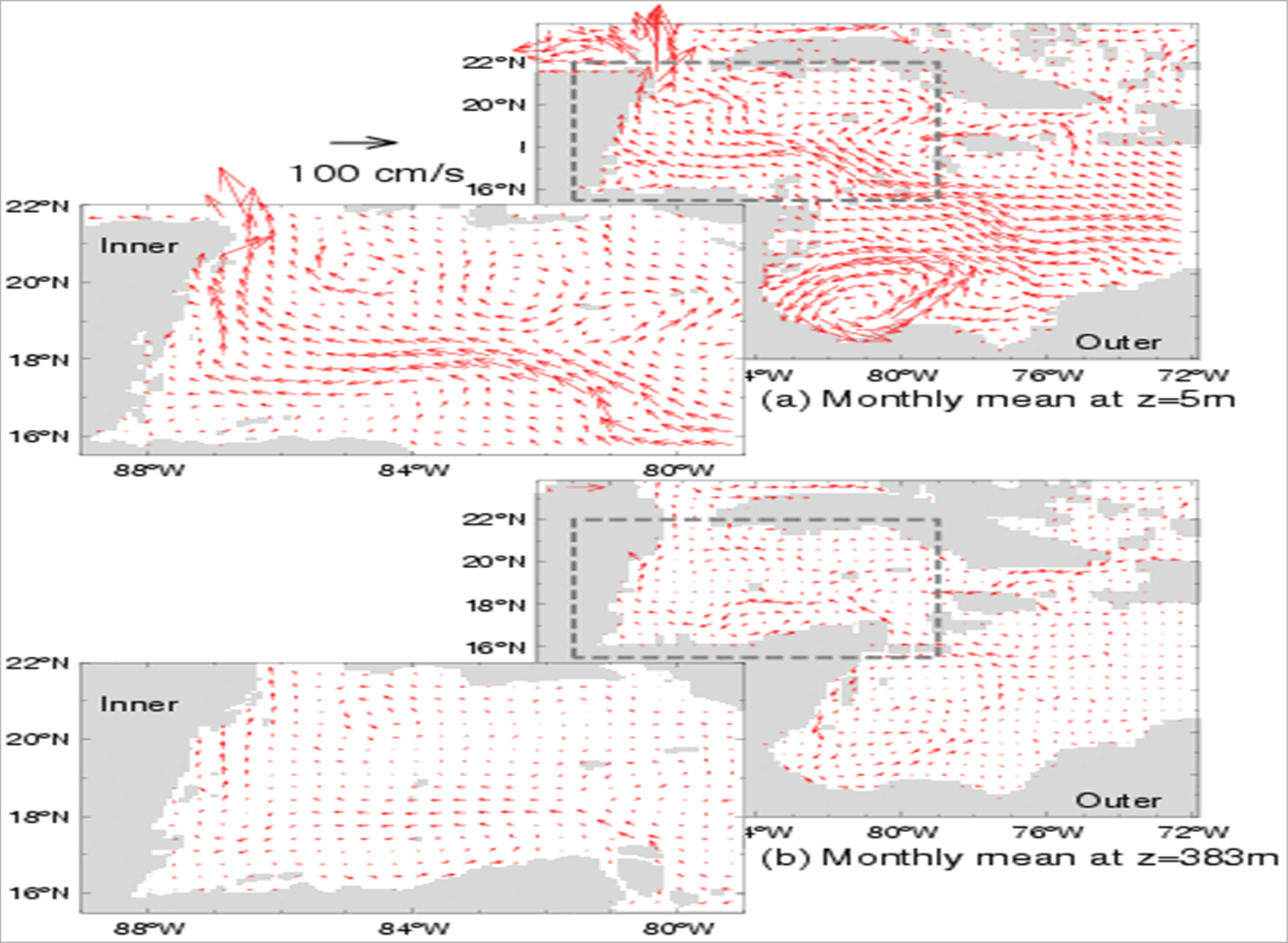
5: Model results We integrate the two-way nested ocean circulation model for two years and calculate the volume transport streamfunction, currents, temperature and salinity from the second year model simulation. (Figure 2, Figure3 and Figure 4 ) 6: Process study
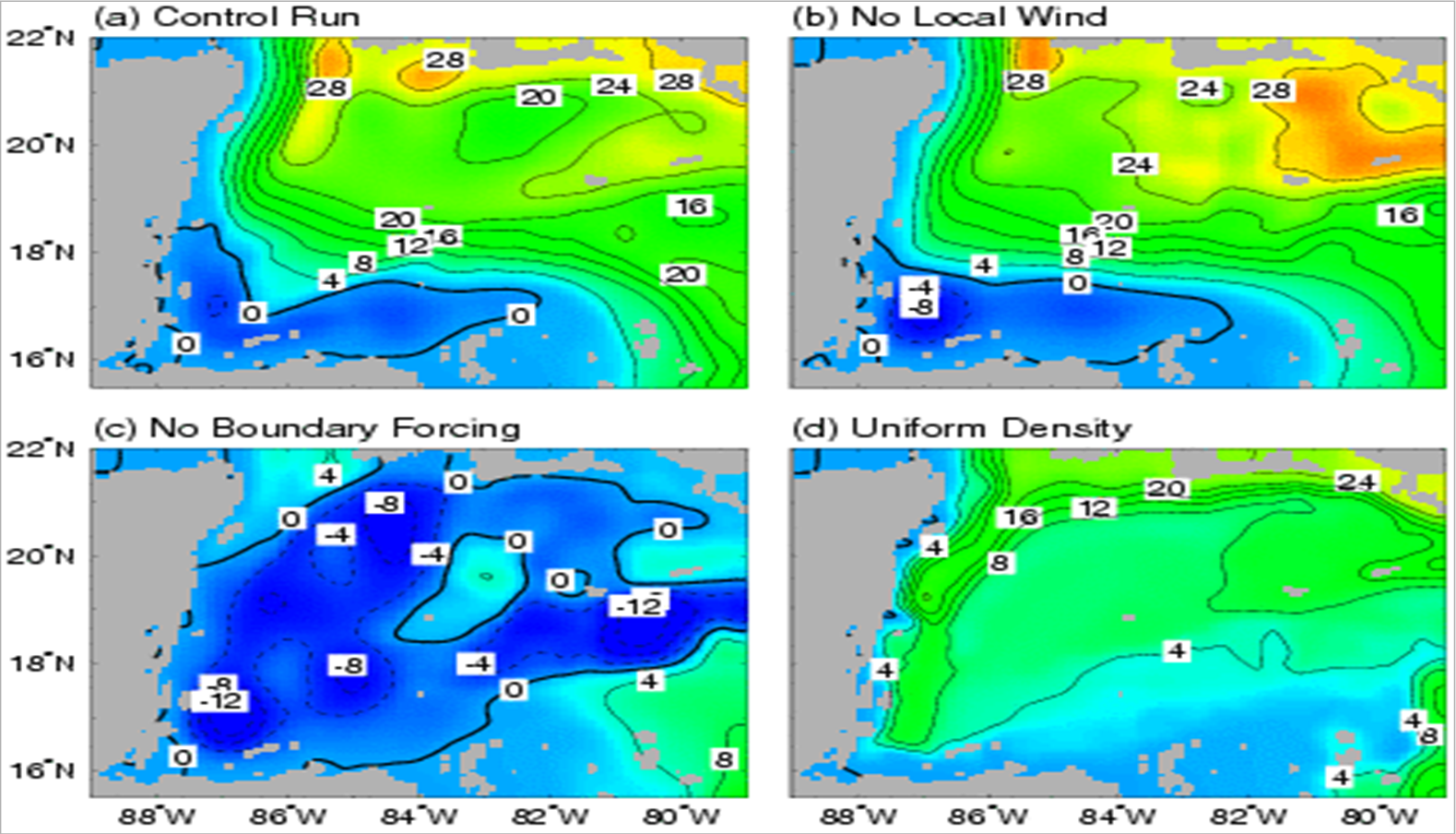
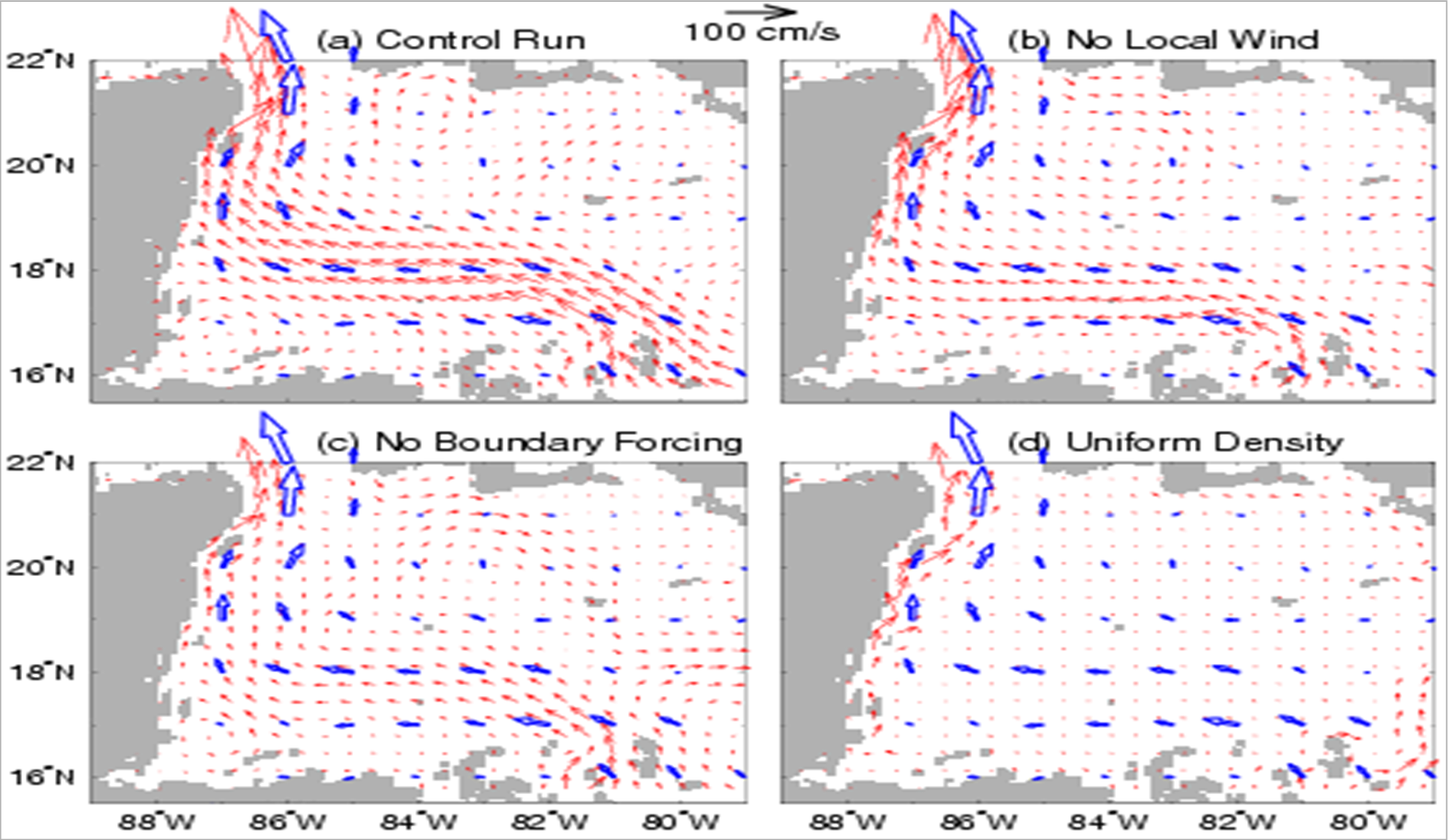
We conduct four numerical experiments
to examine the role of local wind stress, boundary forcing and local
density gradients in the MBRS. In the first experiment (control run),
we integrate the nested-grid model for two years and force the model
with the monthly mean surface flux forcing and monthly mean volume
transport across the outer model open boundaries. In the other three
experiments, we drive the model with the external forcing and model parameters same as those in
the control run except that (a) the local wind stress is set to zero
in the no local wind stress case; (b) volume transport across the
outer model open boundaries is set to zero in the no boundary forcing
case; and (c) temperature and salinity at each model grid point are
set to constant values in the uniform
density case.
7: Summary and conclusion a: A two-way nested-grid ocean circulation model for the MBRS is developed. The outer model is the western Caribbean Sea model with a horizontal resolution of roughly 19 km. The inner model domain is located at MBRS area, with a horizontal resolution of roughly 6 km. b: The semi-prognostic method is used to exchange the model density between the inner and outer models through the horizontal pressure gradient terms in the momentum equations (Sheng et al., 2003). c: The newly-proposed nesting technique is computationally stable and relatively easy to implement. d: The two-way nested model is used to examine the role of the local wind stress, boundary forcing of the outer model, and local density gradients in driving the general circulation in the MBRS. e: The boundary forcing of the outer model and baroclinicity play a very important role in driving the annual mean circulation in the MBRS. The local wind forcing also plays an important role in driving the near-surface circulation. The local wind forcing, however, plays a minor role in driving the depth-integrated flow in the region. 8: References Fratantoni, D. F., 2001: North Atlantic surface circulation during the 1990's observed with satellite-tracked drifters. J. Geophys. Res., 106, 22067-22093. Sheng, J., D. G. Wright, R. J. Greatbatch, and D. E. Dietrich, 1998: CANDIE: A new version of the DieCAST ocean circulation model. J.Atmos. and Ocean. Tech., 15, 1414-1432. Sheng, J., R. J. Greatbatch, and D. G. Wright, 2001: Improving the utility of ocean circulation models through adjustment of the momentum balance. J. Geophys. Res., 106, 16,711-16,728. Sheng, J., and L. Tang, 2003: A numerical study of circulation in the western Caribbean Sea. J. Phys. Ocean., Vol. 33, pp2049~2069. Sheng J., and L. Tang, 2003: A two-way nested-grid ocean circulation model for the Meso-American Barrier Reef System. Ocean Dynamics (in press). Sheng, J., C. Eden, R. J. Greatbatch, L. Tang, and X. Zhai, 2003: A new two-way interactive nesting technique based on the semi-prognostic method. (in prep).
|
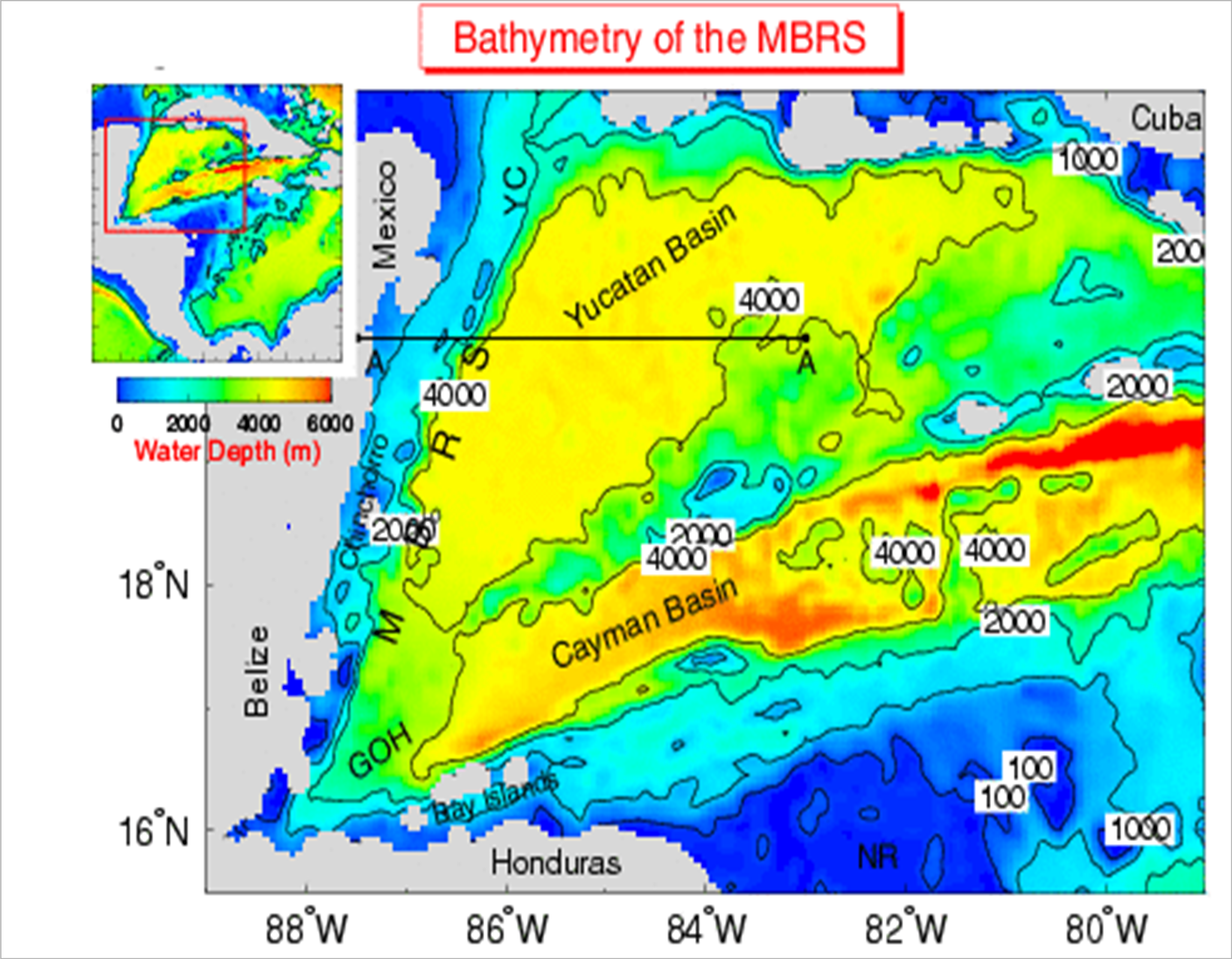
Fig.1: Selected
topographic features within the inner model domain of the nested-grid
model for the MBRS. Inset shows the outer model domain. Abbreviations
are used for the Yucatan Channel (YC), Meso-American Barrier Reef
System (MBRS), Gulf of Honduras (GOH) and Nicaragua Rise (NR).
Contours are labeled in units of meters.
Fig.2 : Annual mean
volume transport streamfunctions calculated from the second year
model results using two-way nesting technique. Contours are
labeled in units of Sv=(10^6m^3/s)
and contour internals are 4 Sv .
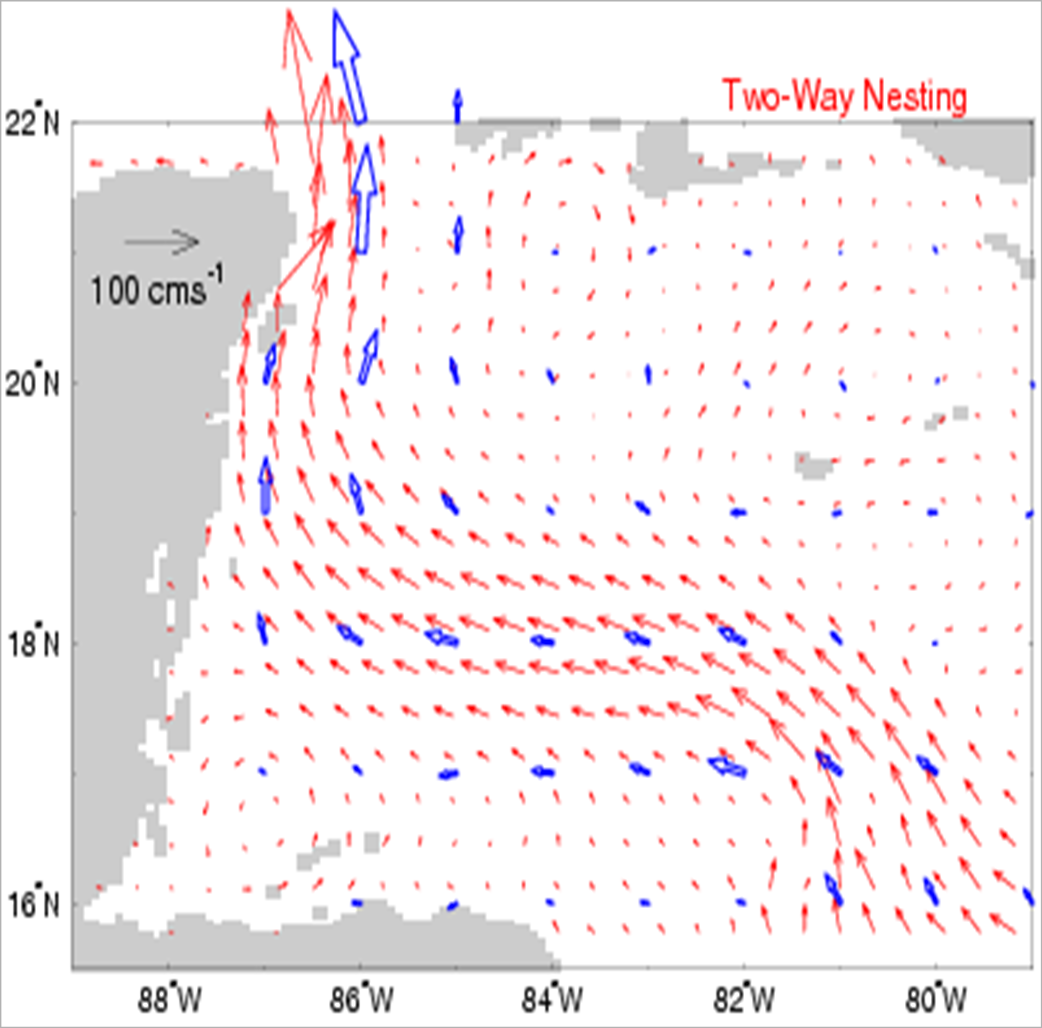
Fig.3: Comparison of model
calculated (solid arrows) and observed (open arrows)
near-surface currents over the MBRS. The model calculated
currents are the annual mean near-surface currents from the
second year results produced by the inner model. The observed
currents are the gridded decadal-mean near-surface currents
inferred by Fratantoni (2001).
Figure 4: January mean near-surface currents at 5 m and sub-surface currents at 383 m calculated from the second year simulations using the two-way nesting technique.
|
|||||
|
Fig.5: Annual mean transport streamfunction calculated by the two-way nested model in the four cases: (a) control run case; (b) no local wind case; (c) no boundary forcing case; and (d) uniform density case.
Figure 6: Annual mean near-surface (solid arrows) at 16m calculated the second year simulations in the four cases. The observed currents (open arrows) are the gridded decadal-mean near surface currents during the 1990s in ferred from trajectories of 15m-drogued satellite-tracked drifters byFratantoni (2001) on one degree grid.
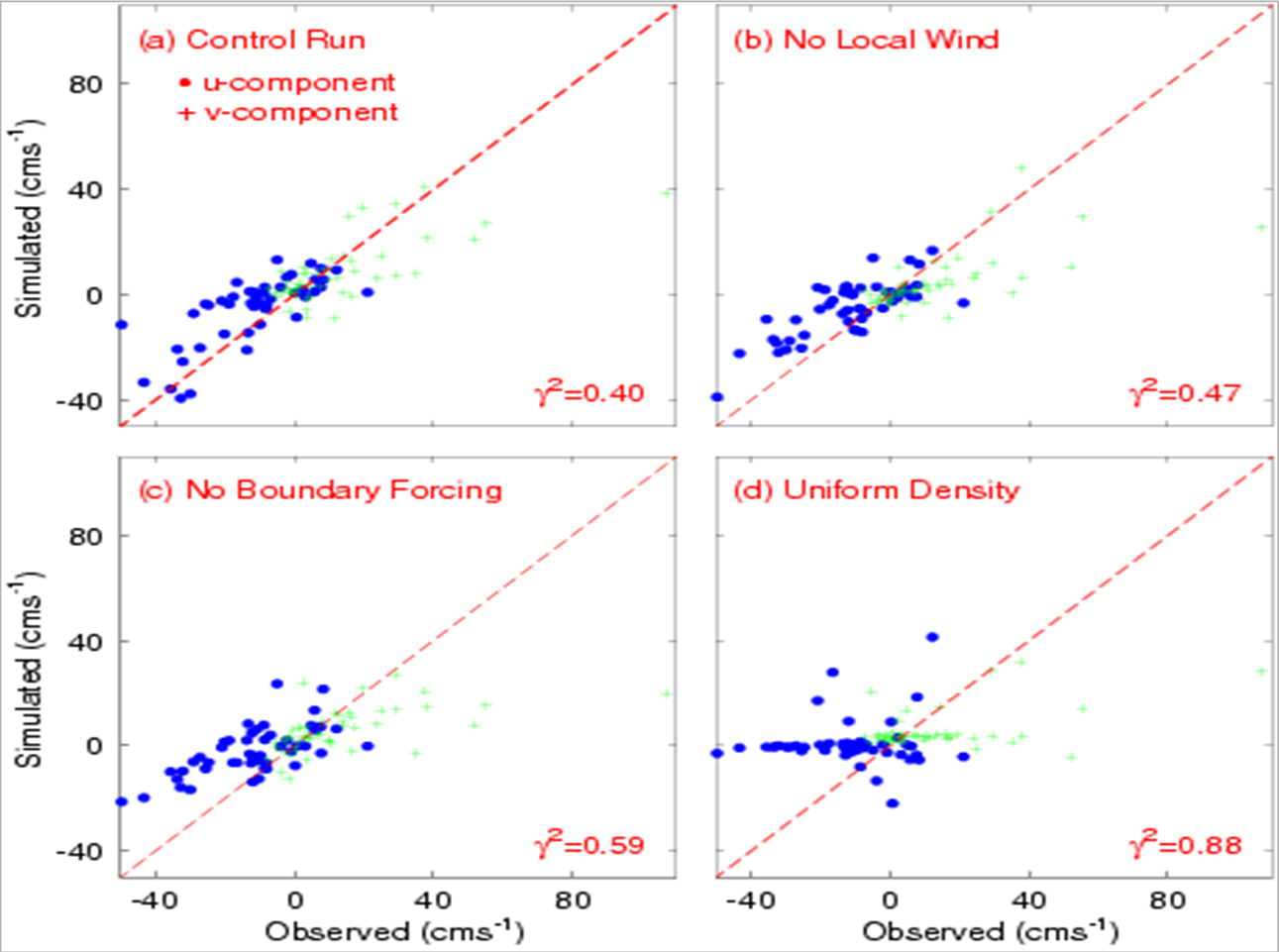
Fig.7:
Scatterplots of observed and model-calculated time-mean near-surface
currents in the four cases. The observed currents are the decadal-mean
near-surface currents during the 1990s inferred from trajectories of
15m-drogued satellite-tracked drifters by Fratantoni (2001). The
model-computed currents are those at the same locations as the
observations interpolated from the second year model simulations in
the four cases. The smaller
|
||||||
|
|
||||||