The Diffusive
Regime in Double Diffusive
Convection: Observational
Aspects
Emin Özsoy
Institute of Marine Sciences,
Middle East Technical University,
P. O. Box 28, Erdemli, Içel
33731 Turkey. e-mail: ozsoy@ims.metu.edu.tr
Introduction
In this section, a brief survey is made of the observations concerning
the diffusive regime of double-diffusive convection, expected to occur
when a destabilizing temperature gradient competes with a statically stable
salinity gradient (e.g. when both temperature and salinity increase with
depth). Laboratory convective layers under similar conditions of a salinity
gradient heated from below have been studied extensively (e.g.,
Turner, 1968; Huppert and Linden, 1979; Fernando, 1987), and many oceanographic
and limnological examples are known (Turner, 1969; Fernando, 1989). Double
diffusive convection is often triggered by horizontal contrasts (e.g.
boundaries, or fronts) and by buoyancy sources (e.g. sources/sinks
of heat or salt) in stratified environments with two diffusing properties,
leading to interleaving layers characterized by a series of alternating
diffusive / fingering interfaces (Turner, 1973, 1978; Huppert and Turner,
1980; Tsinober et al., 1983; Tanny and Tsinober, 1988; Jeevaraj
and Imberger, 1991).
Double diffusive convection is often studied for its own sake, i.e.
as a curiousity of fluid dynamics, applied to specific conditions. It has
long been debated whether the small scale double diffusion process can
have significant impacts on the large scale properties or dynamics of the
marine system. In particular, one would like to answer the following questions
through more extensive observations and theoretical / experimental insights:
what is the overall significance of double-diffusive convection in transporting
mass, momentum, energy and other properties in the ocean ? Does it modify
the time scales of motion, or the structure of the thermohaline circulation
in specific ocean basins ? Can it modify large scale oceanic processes
or is it only important for isolated features such as fronts, eddies, etc.
? What is its relative contribution to mixing, as compared to turbulence
? Does it modify large scale mixing / water mass formation processes ?
How does double-diffusive convection modify effective coefficients of diffusivity
? How is its effects supplemented in the presence of shear and turbulence
?
A description of observational evidence of diffusive contribution to
meso-scale and basin-scale processes is given based on frontline examples.
The Black Sea
The Black Sea (see reviews by Özsoy and Ünlüata, 1997
and 1998) is the largest land-locked basin of the world with a positive
surface water budget. Its effective isolation, despite the existence of
the two-way exchange through the Turkish Straits, has led to stagnant conditions
and anoxia in its deep waters, the average age of water increasing to more
than two thousand years near the bottom (Östlund, 1974; Grasshoff,
1975). The warm and saline Mediterranean Water is the historical source
of the deep waters, evolving since the end of the last ice age (more than
10,000 years ago), when it first penetrated into the fresh water lake known
today as Black Sea (Stanley and Blanpied, 1980).
The Black Sea is probably one of the best places to observe the large
scale effects of double diffusive convection, where it occurs in connection
with (i) the warm, saline Mediterranean water intruding from the Bosphorus
(ii) a diffusive interface capping the bottom convection layer, and (iii)
vertical fluxes in the deep waters.
The historical evolution of the deep waters has resulted in a peculiar
distribution of the 'density ratio'  such that the entire water column is formally in the diffusive instability
range, changing from minimum values (
such that the entire water column is formally in the diffusive instability
range, changing from minimum values (  )
at the top (below the mixed layer) and bottom (above the bottom convective
layer), to marginally stable values (
)
at the top (below the mixed layer) and bottom (above the bottom convective
layer), to marginally stable values (  )
at a depth of
)
at a depth of  (Özsoy et al 1993).
The dense bottom water of Mediterranean origin (modified in the Turkish
Straits and across the continental shelf) cascading down the continental
slope degenerates into discrete layers (depth range 100-500m) of
double diffusive convection penetrating into the interior (Özsoy et
al., 1993, Özsoy and Besiktepe, 1995). The unstable interior is
expected to enhance the convection (e.g. Turner, 1978), in addition
to the effects of sidewall buoyancy source (heat and salt) introduced into
the stratified environment (e.g. Tsinober et al., 1983; Tanny
and Tsinober, 1988).
Boundary mixing (e.g. Garrett, 1990; Woods, 1991), in this case
driven by the double diffusive convection (Özsoy et al., 1993,
Özsoy and Besiktepe, 1995), appears to be the dominant ventilation
mechanism across the permanent halocline of the Black Sea, as it has been
amply demonstrated by transport of shelf-derived materials, including dissolved
nutrients, Chernobyl tracers and inorganic particulates (Buesseler et
al., 1991; Buesseler and Livingston, 1997, Codispoti et al.,
1991; Özsoy et al., 1991, 1993). The relatively rapid penetration
of tracers across the halocline, contrasting with almost none in the deep
water has been confirmed by Tritium (Top et al., 1991, Top, 1997,
Rank et al., 1997) and Carbon-14 (Östlund, 1974, 1986) measurements.
Plume parameterization of vertical mixing in general circulation models
(Stanev and Staneva, 1996) has significantly improved the simulation of
ventilation and tracer distributions in the Black Sea.
A bottom convection layer, with a thickness of  forms the largest known example in the world ocean. A destabilizing geothermal
heat flux of
forms the largest known example in the world ocean. A destabilizing geothermal
heat flux of  at the bottom acts against an otherwise stable salinity stratification.
The transport between the bottom convective layer and the overlying waters
occurs through a single diffusive interface. The observed features and
the parametric setting suggest that the convective layer is far from the
initial phase of growth proportional to t1/2 (e.g.,
Turner, 1968; Huppert and Linden, 1979, Fernando, 1987; Fernando, 1989),
and corresponds with the long time limit of the 'low stability regime'
of Fernando (1987, 1989) and Fernando and Ching (1991), in which the interfacial
entrainment, and therefore layer growth become negligibly small (Özsoy
et al., 1991; Özsoy and Besiktepe, 1995). The heat flux at
the the stable Black Sea interface (
at the bottom acts against an otherwise stable salinity stratification.
The transport between the bottom convective layer and the overlying waters
occurs through a single diffusive interface. The observed features and
the parametric setting suggest that the convective layer is far from the
initial phase of growth proportional to t1/2 (e.g.,
Turner, 1968; Huppert and Linden, 1979, Fernando, 1987; Fernando, 1989),
and corresponds with the long time limit of the 'low stability regime'
of Fernando (1987, 1989) and Fernando and Ching (1991), in which the interfacial
entrainment, and therefore layer growth become negligibly small (Özsoy
et al., 1991; Özsoy and Besiktepe, 1995). The heat flux at
the the stable Black Sea interface (  ),
estimated from the Huppert and Linden (1971) and Fernando (1989) models
were about 5-8 times larger than the geothermal heat flux from the bottom,
since these models typically overestimate fluxes when the Richardson number
),
estimated from the Huppert and Linden (1971) and Fernando (1989) models
were about 5-8 times larger than the geothermal heat flux from the bottom,
since these models typically overestimate fluxes when the Richardson number 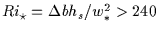 (Fernando, 1989,
  is the buoyancy step, hs the layer thickness and ws
a vertical velocity scale for convection), and most probably do not apply
in the long time limit not adequately investigated in the laboratory studies
on which they are based.
is the buoyancy step, hs the layer thickness and ws
a vertical velocity scale for convection), and most probably do not apply
in the long time limit not adequately investigated in the laboratory studies
on which they are based.
The bottom convective layer is expected to have a similar age as the
deep waters (few thousands of years). The observed homogenisation of water
properties vertically and across the basin inside the convective layer
is expected to occur in about 40 years, which may also have bearing on
the homogeneity in deposition/diagenesis of bottom sediments (Özsoy
et al., 1991; Özsoy and Besiktepe, 1995).
Based on comparison of flux ratios above the diffusive interface and
the water column, double diffusion is most likely to be the main vertical
transport mode for heat and salt in the deep waters extending from the
lower part of the pynocline to the diffusive interface above the bottom
convective layer (Özsoy et al., 1991; Murray et al.,
1991). The observed 'S-shape' of the  curves in the Black Sea deep waters also leads one to expect that it has
been generated by the different diffusivities of salt and heat (Mamayev,
1975, 1995).
curves in the Black Sea deep waters also leads one to expect that it has
been generated by the different diffusivities of salt and heat (Mamayev,
1975, 1995).
Polar Seas
Double diffusive staircases have frequently been observed at polar seas,
where cold, low salinity surface waters affected by surface cooling and
fresh water from rivers and glacial ice, overlying warmer more saline waters
entering from other ocean basins create a suitable environment. Because
some parts of these ice covered seas are low-energy environments, especially
at the central gyre areas, double diffusion can play a significant role
compared to shear and turbulence effects, especially in the internal redistribution
of heat and other properties.
Foster and Carmack (1976) have found staircase structures in the Weddell
Sea in the Antarctic, where both double diffusive and cabelling intabilities
appeared to be important. Muench, et al. (1990) also found similar,
unstable staircases (  in both papers), and also showed that the heat transported vertically by
the deeper, 'Type B' staircases below the pycnocline (
in both papers), and also showed that the heat transported vertically by
the deeper, 'Type B' staircases below the pycnocline (  )
was close to the independent estimates of heat transported (
)
was close to the independent estimates of heat transported (  )
through the pycnocline by budget considerations. Robertson, et al.
(1995) observed step structures during part of their measurements from
a drifting ice station in Weddell Sea, and estimated heat fluxes of 2 W/m2
at the permanent pycnocline, which were larger than the contribution of
shear instabilities (1 W/m2), but still much less
than the 19 W/m2 required by the gyre scale heat
budget.
)
through the pycnocline by budget considerations. Robertson, et al.
(1995) observed step structures during part of their measurements from
a drifting ice station in Weddell Sea, and estimated heat fluxes of 2 W/m2
at the permanent pycnocline, which were larger than the contribution of
shear instabilities (1 W/m2), but still much less
than the 19 W/m2 required by the gyre scale heat
budget.
Although diffusive staircases have also been observed in the Arctic
Sea (Padman and Dillon, 1987, 1989), the estimated fluxes were much smaller
than the Antarctic, on the order of 0.1 W/m2,
which was not sufficient to explain basin average fluxes of heat between
waters of Arctic and Atlantic origin. Other processes such as benthic and
boundary stirring were invoked. During a survey of the central Arctic Sea
in summer 1996, Muench, et al. (1997) found steplike features of
up to 100m in thickness, conserving their features for more than
a distance of 500km, yet containing water of ages differing by a
few years.
'Saline' Lakes
In some lakes, total dissolved constitute the 'salinity', and salt stratification
can be sufficient to stabilize the lake against the action of bottom heating.
An example of such a lake is Lake Vanda in Antarctica (Fernando, 1989,
and references cited therein). Newman (1976) found a similar situation
in Lake Kivu, where he also observed double diffusive steps. The estimated
heat flux (  )
was an order of magnitude larger than the bottom heat flux from sediments,
and is conjectured to balance with other possible sources of heat, from
bottom hot springs or bacterial activity. The
)
was an order of magnitude larger than the bottom heat flux from sediments,
and is conjectured to balance with other possible sources of heat, from
bottom hot springs or bacterial activity. The  values were in the range 1.3-2.1, suggesting unstable layers, while the
estimated and observed layer thickness values were close to each other.
values were in the range 1.3-2.1, suggesting unstable layers, while the
estimated and observed layer thickness values were close to each other.
Brine 'Lakes'
The other example of diffusive interfaces occurs at small pockets of
saline water trapped near the ocean bottom in the form of 'trenches' or
'lakes', where there is also a supply of geothermal heat either from sediments
or hot vents. Swallow and Crease (1965) found sharp interfaces bounding
layers of hot salty water at the bottom of the Red Sea. Turner (1969) calculated
the geothermal heat flux to be 215 mW/m2
and found interfacial
values in the range of 9-25. The average age of the water in the brine
layer was estimated to be 30 years. Brine 'lakes' were also found in the
deep eastern Mediterranean basin by Boldrin and Rabitti (1990), where the
density ratio was very high,  ,
and the interfacial heat flux was estimated to be of the same order as
the geothermal flux of 46 mW/m2. Both these estimates
and isotopic composition (Stenni and Longinelli, 1990) suggested that the
water in the bottom layer was of 'fossil' origin, probably developed about
4500 years or earlier. Similar features were found in other Eastern Mediterranean
brine lakes (MEDRIFF Consortium, 1995), which also showed the recent invasion
of a new dense water mass of Aegean Sea origin (Roether, 1996). The warmer
more saline deep waters after the renewal event are warmer but less saline
than the fossil water below the interface, making the interface stable.
It appears that brine lakes can memorize the deep water history of a basin,
if the information they hold can be correctly interpreted.
,
and the interfacial heat flux was estimated to be of the same order as
the geothermal flux of 46 mW/m2. Both these estimates
and isotopic composition (Stenni and Longinelli, 1990) suggested that the
water in the bottom layer was of 'fossil' origin, probably developed about
4500 years or earlier. Similar features were found in other Eastern Mediterranean
brine lakes (MEDRIFF Consortium, 1995), which also showed the recent invasion
of a new dense water mass of Aegean Sea origin (Roether, 1996). The warmer
more saline deep waters after the renewal event are warmer but less saline
than the fossil water below the interface, making the interface stable.
It appears that brine lakes can memorize the deep water history of a basin,
if the information they hold can be correctly interpreted.
McDougall (1984) investigated brine layers capped by a double diffusive
interface and supplied by hot saline plumes in a depression, as in the
case of the Red Sea brine layers, and found the system to converge to a
stablle fixed point in T-S space, which may explain their stationary character.
REFERENCES
Boldrin, A. and S. Rabitti, 1990. Hydrography of the Brines in the Bannock
and Tyro Anoxic Basins (eastern Mediterranean), Marine Chemistry,
31, 21-33.
Buesseler, K. O., Livingston, H. D., and S. Casso, 1991. Mixing Between
Oxic and Anoxic Waters of the Black Sea as Traced by Chernobyl Cesium Isotopes,
Deep-Sea Res., 38, S725 - S745.
Buesseler, K. O. and H. D. Livingston, 1997. Time-Series Profiles of
134Cs, 137Cs and 90Sr in the Black Sea, in: E. Özsoy and A. Mikaelyan
(editors), Sensitivity to Change: Black Sea, Baltic Sea and North Sea,
NATO ASI Series, Kluwer Academic Publishers.
Fernando, H. J. S., 1987. The Formation of Layered Structure when a
Stable Salinity Gradient is Heated from Below, J. Fluid Mech., 182,
525-541.
Fernando, H. J. S., 1989. Oceanographic Implications of Laboratory Experiments
on Diffusive Interfaces, J. Phys. Oceanogr., 19, 1707-1715.
Fernando, H. J. S., and C. Y. Ching, An Experimental Study on Thermohaline
Staircases, 1991. In: Double Diffusion in Oceanography, Proceedings
of a Meeting, September 26-29, 1989, R. W. Schmitt (editor), Technical
Report, Woods Hole Oceanographic Institution, 141-149.
Foster, T. D. and E. C. Carmack, 1976. Temperature and Salinity Structure
in the Weddell Sea, J. Phys. Oceanogr., 6, 36-44.
Garrett, C., 1990. The Role of Secondary Circulation in Boundary Mixing,
J. Geophys. Res., 95, 3181-3188.
Grasshoff, K., 1975. The Hydrochemistry of Landlocked Basins and Fjords,
In: Chemical Oceanography, J. P. Riley and G. Skirrow (editors),
Academic Press, New York, 2, 647 pp.
Huppert, H. E. and P. F. Linden, 1979. On Heating a Salinity Gradient
from Below, J. Fluid Mech., 95, 431-464.
Huppert, H. E. and J. S. Turner, 1980. Ice Blocks Melting Into a Salinity
Gradient, J. Fluid Mech., 100, 367-384.
Mamayev, O. I., 1975. Temperature - Salinity Analysis of World Ocean
Waters, Elsevier, Amsterdam, 374 pp.
Mamayev, O. I., 1995. The Black Sea: The Double-Diffusive Process in
the light of the Analytical Theory of T,S Curves, Oceanology, 35(2),
153-160.
McDougall, T. J. 1984. Fluid Dynamical Implications for Massive Sulphide
Deposits of Hot Saline Fluid Flowing into a Submarine Depression from Below,
Deep-Sea Res., 31, 145-170.
MEDRIFF Consortium, 1995. Three Brine Lakes Discovered in the Seafloor
of the Eastern Mediterranean, EOS, 76(33), 313-318.
Muench, R. D. H. J. S. Fernando and G. R. Stegen, 1990. Temperature
and Salinity Staircases in the Northwestern Weddell Sea, J. Phys. Oceanogr.,
20, 295-306.
Muench, R. D., B. Rudels, G. Bjork and U. Schauer, 1997. Basin Scale
Double-Diffusive Layering in the Arctic Ocean, Abstracts booklet, 'Marine
Turbulence Revisited', 29th International Liege Colloquium on Ocean Hydrodynamics,
Liege, May 5-9, 1997.
Murray, J. W., Z. Top and E. Özsoy, 1991. Hydrographic Properties
and Ventilation of the Black Sea, Deep-Sea Res., 38, Suppl.
2, S663-S689.
Newman, F. C., 1976. Temperature Steps in Lake Kivvu: A Bottom Heated
Saline Lake, J. Phys. Oceanogr., 6, 157-163.
Östlund, H. G., 1974. Expedition Odysseus 65: Radiocarbon Age of
Black Sea Water, In: The Black Sea - Geology, Chemistry and Biology,
E. T. Degens and D. Ross (editors), The American Association of Petroleum
Geologists, Memoir No. 20.
Östlund, H. G. and D. Dyrssen, 1986. Renewal Rates of the Black
Sea Deep Water, In: The Chemical and Physical Oceanography of the Black
Sea, Univ. of Göteborg, Rep. on the Chemistry of the Sea XXXIII.
Presented in the Meeting on the Chemical and Physical Oceanography of the
Black Sea, Göteborg, Sweden, June 1986.
Özsoy E., Z. Top, G. White and J. W. Murray, 1991. Double Diffusive
Intrusions, Mixing and Deep Convective Processes in the Black Sea, In:
Black Sea Oceanography, NATO ASI series C - Vol. 351, E. zdar and
J. W. Murray (editors), Kluwer Academic Publishers, 17-42.
Özsoy, E., Ü. Ünlüata, and Z. Top, 1993. The Mediterranean
Water Evolution, Material Transport by Double Diffusive Intrusrions, and
Interior Mixing in the Black Sea, Prog. Oceanogr., 31, 275-320.
Özsoy, E. and S. Besiktepe, 1995. Sources of Double Diffusive Convection
and Impacts on Mixing in the Black Sea, pp. 261-274, in: Brandt, A. and
H. J. S. Fernando (editors), Double-Diffusive Convection, Geophysical
Monograph 94, American Geophysical Union, 334 pp.
Özsoy, E. and Ü. Ünlüata (1997). Oceanography of
the Black Sea: A Review of Some Recent Results, Earth Sci. Rev.,
42(4), 231-272.
Özsoy, E. and Ü. Ünlüata (1998). The Black Sea,
in: A. R. Robinson and K. Brink (editors), The Sea: The Global Coastal
Ocean: Regional Studies and Syntheses, 11, John Wiley and Sons,
New York, pp. 889-914.
Padman, L. and T. M. Dillon, 1987. Vertical Heat Fluxes through the
Beaufort Sea Thermahaline Staircase, J. Geophys. Res., 92,
10799-10806.
Padman, L. and T. M. Dillon, 1989. Thermal Microstructure and internal
Waves in the Canada Basin Diffusive Staircase, Deep-Sea Res., 36,
531-542.
Robertson, R., L. Padman, and M. Levine, 1995. Fine Structure, microstructure,
and Vertical Mixing Processes in the Upper Ocean in the Western Wedell
Sea, J. Geophys. Res., 100, 18517-18535.
Stanley, D. J., and C. Blanpied, 1980. Late Quaternary Water Exchange
between the Eastern Mediterranean and the Black Sea', Nature, 285,
537-541.
Stenni, B. and A. Longinelli, 1990. Stable Isotope Study of Water, Gypsum
and Carbonate Samples from the Bannock and Tyro Basins, Eastern Mediterranean,
Marine Chemistry, 31, 123-135.
Swallow, J. C. and J. Crease, 1965. Hot Salty Water at the Bottom of
the Red Sea, Nature, 205, 165-166.
Tanny, J., and A. B. Tsinober, 1988. The Dynamics and Structure of Double-Diffusive
Layers in Sidewall Heating Experiments, J. Fluid Mech., 196,
135-156.
Turner, J. S., 1968. The Behaviour of a Stable Salinity Gradient Heated
from Below, J. Fluid Mech., 33(1), 183-200.
Turner, J. S.,1969. A Physical Interpretation of Hot Brine Layers in
the Red Sea, In: Hot Brines and Recent Heavy Metal Deposits in the Red
Sea, E. T. Degens and D. A. Ross (editors), Springer, New York, 164-172.
Turner, J. S., 1973. Buoyancy Effects in Fluids, Cambridge University
Press, 367 pp.
Turner, J. S., 1978. Double-Diffusive Intrusions into a Density Gradient,
J. Geophys. Res., 83, 2887-2901.
Woods, A. W., 1991. Boundary-Driven Mixing, J. Fluid Mech., 226,
625-654.
Emin Ozsoy
1999-10-28